Friday, May 28, 2010
A Real Spectacle
Here's my first attempt at sharing a short (5 second) video from my Canon pocket camera. This was the scene a couple of days ago on the Punta de Cacao road on the Gallon Jug Estate. The frogs were going CRAZY calling -- it was deafening! We'd had 2.2-inches of rain the previous night -- on top of all the rain of the previous few days -- and they were taking advantage of it. You can see there is water over the road and a seasonal pool at the side of the road. I couldn't get close enough to the skittish frogs in order to get any close up photos this time.
There were several species though, primarily the Mexican tree frog (Smilisca baudinii), Sheep frog (Hypopachus variolosus), and the Red-eyed tree frog (Agalychnis callidryas). With amphibians and their habitats under pressure in so many places in the world, witnessing such a "spectacle of nature" with hundreds (thousands?) of frogs, was really exciting.

Thursday, May 27, 2010
Kitty's in the Neighborhood
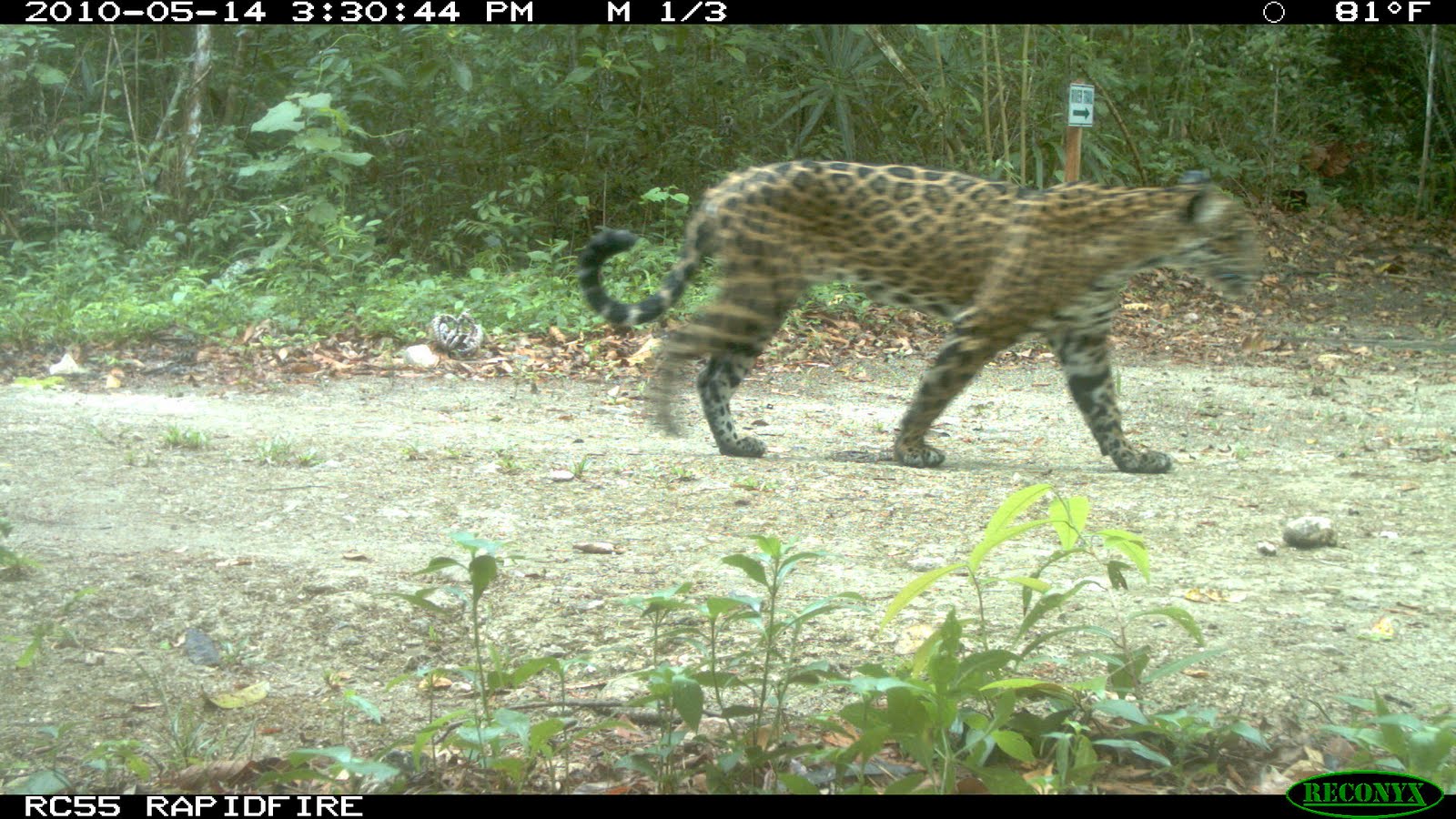 What can I say, it is always nice to see the jaguar known as Kitty Carlisle. And here she is, moving fairly rapidly, through the Bajo Trail intersection at Chan Chich Lodge. She's made regular appearances near the Lodge with a portfolio dating back to 2004. I keep hoping sometime she'll bring her offspring by the camera (since she's almost certainly had young every other year or so), but it hasn't happened yet.
Female jaguars, as it turns out, are fairly secretive and not photographed as often as males by the camera traps. This is borne out with my own data, and that of colleagues. Still, on occasion, I've met a researcher who has shown me camera trap photos of young jaguars in their study area -- I'm envious! It hasn't happened here yet although there are plenty of eye witness reports (sadly, I am not among those that have seen a jaguar cub). At any rate, clearly the Kitty feels confident in the Chan Chich neighborhood to venture out during all hours.
Tuesday, May 25, 2010
Mid-May Ocelots
 It's been a bit of a dry spell between camera trap photos. The camera I've been using has been in for cleaning and repairs recently (it's been doing things like shooting 1700+ images of "nothing" in 1 hour) but it's now back in service. Luckily Ben came through with this nice pair of mid-May ocelot photos from Chan Chich Lodge, the Bajo Trail.
One was shot on May 13 and the other on May 16. It's not entirely straightforward to compare the two images but from what I can tell by zooming in, this is not the same individual. The ocelot in profile (lower picture) is certainly a familiar-looking male often photographed in this Bajo Trail intersection near the Lodge.
Friday, May 21, 2010
New on the Scene
 I admit it, I was a horse crazy kid. So I couldn't resist a photo of this newcomer on the Gallon Jug farm scene. Evidently she was a "surprise," born on 3 May. Just-turned-five year old Liza, who shares the same birthday, named her "Blondie." Love the crescent moon between her eyes.
Eddie, who manages the Gallon Jug cattle and horses, said they began suspecting something when they had to let out the saddle girth a notch or two on the mare. Evidently there are 3 other mares with the same "problem" and evidently, 3 more "surprises" on the way!
Thursday, May 20, 2010
Socially Acceptable

This hanging basket on our veranda contains what is left of my sickly vanilla orchid. I've been nurturing it for a couple years in the vain hope it might produce a vanilla bean. Just when I'd decided it was unlovely -- a real basket case if you will -- this Social Flycatcher (Myiozetetes similis) apparently found it very hospitable. In fact, she and her mate built a cozy fluffy nest in it over a matter of days.
Social Flycatchers are common throughout Belize, Mexico, Central and South America. They are beautiful and outgoing, brown, yellow, black and white birds that do well in human-modified landscapes. When I last checked, there was one egg in the nest but I'm betting there are at least 4 by now. It's not the first time the Socials have nested on our veranda ... and I'm glad they found my ailing plant "socially acceptable."
Tuesday, May 18, 2010
Gumbo Limbo to the Rescue
 So you've accidentally rubbed up against a chechem, aka black poisonwood, tree. Now what? Antihistamines give limited relief, at least in our experience. Well, you can look around for a gumbo limbo (Bursera simaruba) tree. It's easily recognizable by its papery red bark and is nearly always found growing alongside the chechem (an aside: Gumbo limbo is also known as the Tourist Tree -- red and peeling). Nice of Nature to arrange things so conveniently.
That's the case in this photo above, taken on our hill here in Gallon Jug Estate. The gumbo limbo is surrounded by small chechem trees (the light barked trees). So you take your machete -- in Belize you must always have your trusty machete when in the bush -- and skin off a slice of the gumbo limbo bark. In desperate cases, you can apply the woody side of the bark to the chechem rash and get immediate relief. Or you can take it home, chop it up and brew a sort of tea with it to sponge on the chechem rashes. It really works ... and you'll never buy Benedryl again.
At least not for chechem.
Friday, May 14, 2010
Chechem

The chechem trees are fruiting on our hill. I give them a wide berth, a really wide berth. That's because I know from personal experience that chechem, or black poisonwood, really is POISON -- or more accurately, contains a powerful allergen called urushiol. Reason enough to steer clear.
Brushing up against this tree, Metopium brownei, results in contact dermatitis. Like poison ivy, which is in the same family (Anacardiaceae) along with poison oak, poison sumac, mangos and cashews (yes, mangos and cashews!), some people are more sensitive than others.
Bruce is one of those people. He jokes that if he even sees poisonwood, he gets it. We've both had our bouts with it. It turns your skin to leather, itching, red, miserable leather and takes some time to heal. It can go systemic which happened to both of us, in our first years here, before we learned to recognize it. We were down and out for several days, dosing ourselves with antihistamines which seemed to have little to no affect.
That was before we learned of a powerful antidote that was readily available. And better yet, it normally grows near by chechem...
Subscribe to:
Posts (Atom)


 Posts

